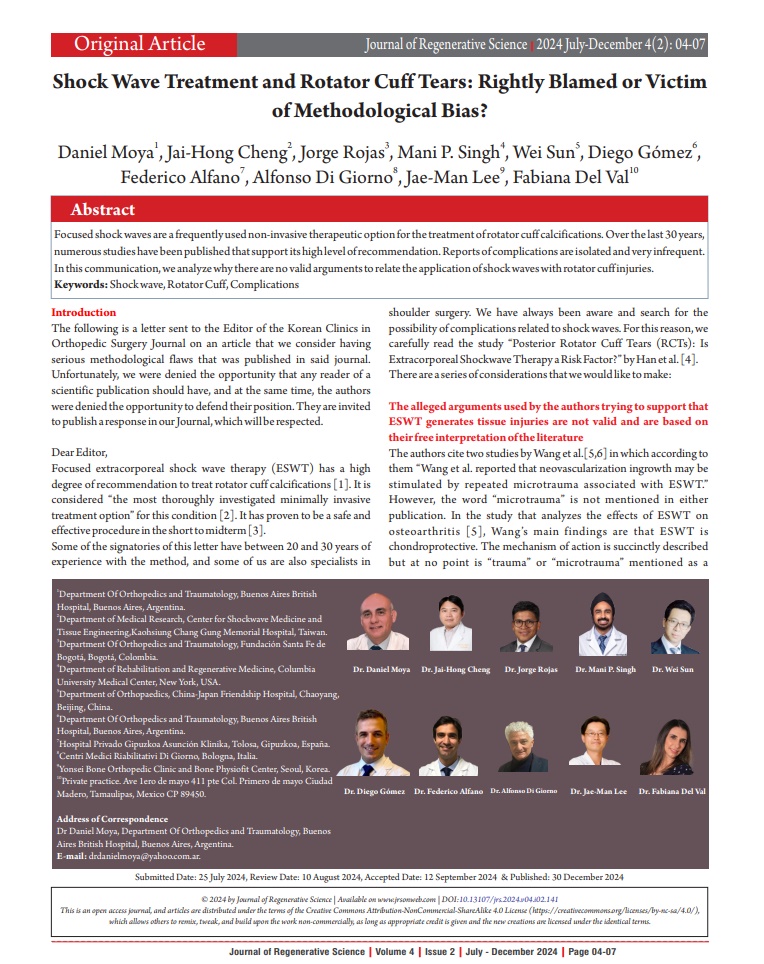
Author: Daniel Moya [1], Jai-Hong Cheng [2], Jorge Rojas [3], Mani P. Singh [4], Wei Sun [5], Diego Gómez [6], Federico Alfano [7], Alfonso Di Giorno [8], Jae-Man Lee [9], Fabiana Del Val [10][1] Department Of Orthopedics and Traumatology, Buenos Aires British Hospital, Buenos Aires, Argentina.
[2] Department of Medical Research, Center for Shockwave Medicine and Tissue Engineering,Kaohsiung Chang Gung Memorial Hospital, Taiwan.
[3] Department Of Orthopedics and Traumatology, Fundación Santa Fe de Bogotá, Bogotá, Colombia.
[4] Department of Rehabilitation and Regenerative Medicine, Columbia University Medical Center, New York, USA.
[5] Department of Orthopaedics, China-Japan Friendship Hospital, Chaoyang, Beijing, China.
[6] Department Of Orthopedics and Traumatology, Buenos Aires British Hospital, Buenos Aires, Argentina.
[7] Hospital Privado Gipuzkoa Asunción Klinika, Tolosa, Gipuzkoa, España.
[8] Centri Medici Riabilitativi Di Giorno, Bologna, Italia.
[9] Yonsei Bone Orthopedic Clinic and Bone Physiofit Center, Seoul, Korea.
[10] Private practice. Ave 1ero de mayo 411 pte Col. Primero de mayo Ciudad Madero, Tamaulipas, Mexico CP 89450.
Address of Correspondence
Dr. Daniel Moya,
Department Of Orthopedics and Traumatology, Buenos Aires British Hospital, Buenos Aires, Argentina.
E-mail: drdanielmoya@yahoo.com.ar
Scientific research is a path to the truth. That is why we were very surprised to read in the Korean Journal of Orthopedics and Traumatology an article by Han et al. which unfoundedly concluded that shock waves could cause damage to the rotator cuff. Having found many errors in the article, we wrote a letter to the Editor, which contrary to usual practice was rejected, so we have decided to present our position from the Journal of Regenerative Science as an open letter.
The authors of the article are invited to submit their response because we believe that through discussion and dialogue on solid bases science advances.
Abstract :Focused shock waves are a frequently used non-invasive therapeutic option for the treatment of rotator cuff calcifications. Over the last 30 years, numerous studies have been published that support its high level of recommendation. Reports of complications are isolated and very infrequent. In this communication, we analyze why there are no valid arguments to relate the application of shock waves with rotator cuff injuries.
Keywords: Shock wave, Rotator Cuff, Complications
















 DI GIORNO MEDICAL REHABILITATION SPORT MEDICINE CENTRE
